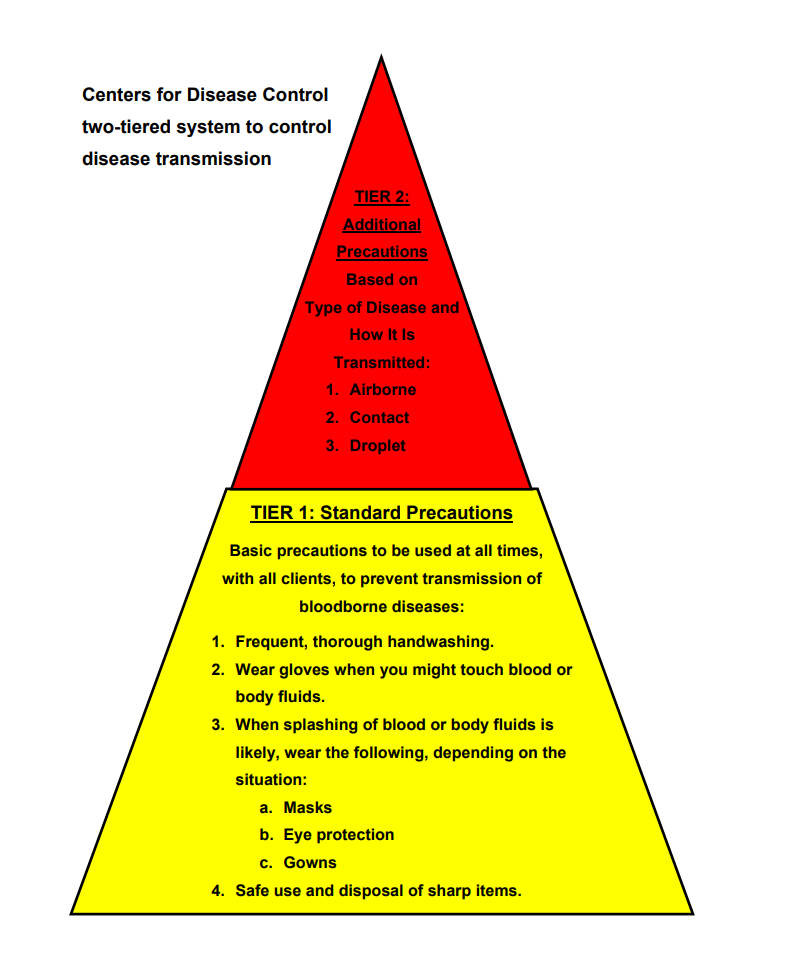
Handwashing is the single most important thing you can do to prevent the
spread of infection. Thorough handwashing removes pathogens from the skin.
Wash hands before and after all client or body fluid contact. Immediately
wash hands and other skin surfaces that are contaminated with blood or body fluids.
When wearing gloves, wash hands as soon as the gloves are removed.
Germicidal handrubs are recommended only when you can’t wash.
2. Do not touch the sink with your hands while you are washing, and stand back from the sink to keep it from touching your clothes.
3. Use warm water. Hot water may dry skin.
4. Either bar soap or liquid soap is okay. If using a bar, rinse it first and hold it the whole time you are lathering. Soap does not have to be an antiseptic type, unless you are doing an invasive procedure such as catheterization.
5. Wet your wrists and hands.
6. Apply plenty of soap. Work up a thick lather all over your hands and wrists, between your fingers and thumbs, and on the back of your hands and wrists.
7. Vigorously rub all areas of your hands, fingers, and wrists for a minimum of 10-15 seconds. Sixty seconds is better.
8. Clean under your nails by using the nails on your other hand, or rub your nails into the palm of your other hand. Clean around the top of your nails.
9. Rinse with warm water, letting water run down from wrists to fingertips and into the sink.
10. Dry with a clean paper towel and throw it away.
11. Turn off the faucet with a clean, dry paper towel and throw the towel away.
12. Use lotion on your hands to prevent irritation and chapping, which makes skin
more prone to infection.
• Use gloves in all situations where you may come in contact with blood or body fluids.
• Use gloves for client care involving contact with mucous membranes, such as brushing teeth.
• Change gloves and wash hands between client contacts.
• Use gloves when you have scrapes, scratches, or chapped skin.
• Do not wash or disinfect disposable gloves for reuse.
Protective barriers, including gloves, reduce the risk of your skin or mucous membranes being exposed to potentially infective blood and body fluids. You should wear the appropriate barriers for the work you are doing.
Employers must provide suitable personal protective equipment (PPE) in the right sizes. Protective equipment includes gloves, gowns, masks, eye protection, face shields, mouthpieces, resuscitation devices, etc. Hypoallergenic gloves, glove liners, powderless gloves, or other alternatives must be available for those who are allergic to latex gloves.
The equipment you need depends on your work. When splashing of blood or body fluids is likely, wear the following PPE in addition to gloves:
• Mask if your face could be splashed with blood or body fluids.
• Eye protection if your eyes could be splashed with blood or body fluids.
• Gown if your clothing or skin could be splashed.
A “sharp” is any object that can penetrate the skin, such as needles, scalpels, broken glass, broken capillary tubes, and exposed ends of wires. A sharp is contaminated if it has been in contact with blood, body fluids, or body tissues.
Contaminated sharps must be disposed of properly. Follow your organization’s policies. A puncture-proof biohazardous container must be used in care facilities. Biohazardous waste from facilities (not from client’s homes) must be disposed of by specially licensed companies.
• Be careful to prevent injuries from needlesticks and other sharp instruments after procedures, when cleaning used instruments, and when disposing of used needles. Do not recap or manipulate needles.
• Nursing and personal care facilities should be using, or planning to use, needleless injection systems or needles with injury protection. If you must use a regular needle, remember:
o Do not recap needles. If it is absolutely necessary to recap a needle,
use one hand to slide the needle into a cap lying on a flat surface. Do not hold the cap in your other hand while recapping.
--Use thick rubber household gloves to protect your hands during housekeeping chores or instrument cleaning involving potential blood contact.
--Treat all linen soiled with blood or body secretions as potentially infectious.
--Surfaces that have been contaminated with blood or body fluids should be cleaned with a disinfectant according to your organization’s policies.